Tibet is a plateau region, housing the Tibetan people. Check out some interesting and fun facts about Tibet.
Facts About Tibet
Tibet is a plateau region, having an average elevation ranging between 14, 000 ft to 16,000 ft. Though UNESCO considers it to be a part of Central Asia, there are many organizations that regard it to be a part of South Asia. Once an independent kingdom, Tibet is now primarily occupied and governed by People’s Republic of China. The unified kingdom of Tibet was ruled over by Songtsän Gampo in the seventh century. This was followed by the rule of Dalai Lamas, from 16th century to 1959. They were recognized as the nominal heads of Tibetan administration, with political powers to govern religious and administrative arenas. Subsistence agriculture is the backbone of Tibetan economy and the main occupation of the Tibetans is raising livestock. Barely is grown in abundance there and Tsampa made from barley flour is the staple food of the Tibetans. For some more interesting and fun facts about Tibet, read on.
-
Archaeological evidences suggest that the Tibetan Plateau was inhabited by humans around 21,000 years ago. However, in around 3,000 BC the Neolithic immigrants from northern China captured the region.
-
Sopngtsan Gampo integrated the regions of Yarlung River Valley and established the Tibetan Empire.
-
By 750 AD the Chinese gained complete control over Tibet. But, later in 751 at the Battle of Talas, Gao Xianzhi was defeated by the Arabs and Qarluqs and four years later a civil war ensued. These two factors contributed immensely to the decline of the Chinese control over Tibet and in 822 AD, Tibet and China signed a peace treaty.
-
The Kingdom of Nanzhao was controlled by the Tibetans from 750 to 794. Later, The Nanzhaos stood up against the Tibetans and with the aid of the Chinese army defeated the Tibetans.
-
In 1834 the Sikh Empire attacked the region and annexed Ladakh into their territory. Though, Ladakh was an independent kingdom at the time, it was culturally Tibetan. Seven years later, when a Sikh army led by General Zorawar Singh launched an attack on western Tibet from Ladakh, the Sino-Sikh War ensued.
-
Tibet is the highest region on Earth and is commonly referred to as the ‘Roof of the World.’
-
The currency of Tibet is Chinese Yuan Renminbi.
-
Though Tibetan is largely spoken in Tibet, the official language is Chinese.
-
The staple food of Tibetan is Tsampa (roasted barley flour), while the national drink is salted butter tea.
-
The most famous animal belonging to Tibet is Yak, which provides manifold services.
-
The world’s highest mountain Mt. Everest which has an elevation of 8,848 meters is located on the border of Nepal and Tibet. Tibet is also known as the ‘Water Tower of Asia’.
-
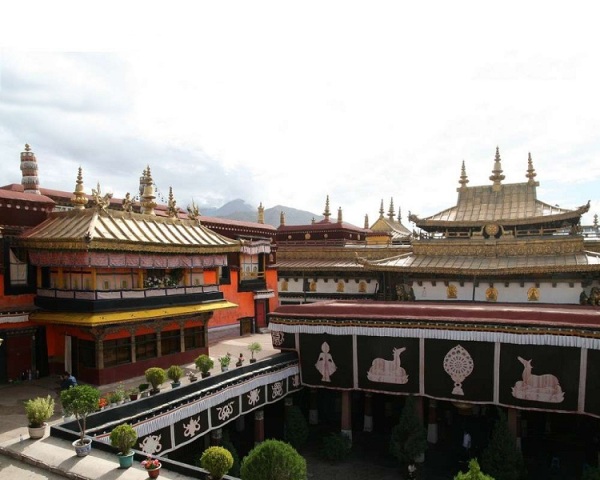
There are two world Heritage sites located in Tibet, Potala Palace and Norbuligka, which were the former residences of the Dalai Lama.
-
Tibet has an agricultural economy, with most of the people being farmers and herders.
-
The Qinghai-Tibet Railway line, linking the region to Qinghai in China, is the world’s highest railway line.
-
Tibetan Buddhism is the most widely followed religion in Tibet.
-
The Tibetan new year festival is known as Losar.
-
The prime crop of Tibet is barley.
-
The current Dalai Lama is Tibet's political and spiritual leader, who fled from Tibet in 1959 and came to Dharamshala, India.
-
Dalai Lama, along with over 100,000 Tibetans, established the Tibetan Government-in Exile, which is a parliamentary form of government, with its base in Dharamshala, India. It is not recognized by any country of world.
-
The current Dalai Lama of Tibet was given the Nobel Peace Prize in 1989, for his consistent efforts for liberation of Tibet, based on non-violence.
-
Dalai Lamas are considered to be the bodhisattva of compassion
-
Tibet has been under the control of China since 1951.
-
The Tibet Autonomous Region, which is commonly referred to as Tibet, is only a part of the historic country of Tibet, created by China for administrative purposes.
-
The historic country of Tibet comprises of three provinces of Amdo (now split by China into the provinces of Qinghai, Gansu & Sichuan), Kham (largely incorporated into the Chinese provinces of Sichuan, Yunnan and Qinghai) and U-Tsang (which, together with western Kham, is today referred to by China as the Tibet Autonomous Region).
-
The major rivers flowing through Tibet are Mekong, Yangtse, Salween, Tsangpo and Yellow.


See also
More from iloveindia.com
- Home Remedies | Ayurveda | Vastu | Yoga | Feng Shui | Tattoos | Fitness | Garden | Nutrition | Parenting | Bikes | Cars | Baby Care | Indian Weddings | Festivals | Party ideas | Horoscope 2015 | Pets | Finance | Figures of Speech | Hotels in India : Delhi | Hyderabad | Chennai | Mumbai | Kolkata | Bangalore | Ahmedabad | Jaipur
- Contact Us Careers Disclaimer Privacy Policy Advertise With Us Lifestyle Sitemap Copyright iloveindia.com. All Rights Reserved.