Leaning Tower of Pisa, in Italy, is one of the most intriguing architectural marvels in the world. Check out some interesting and fun facts about Leaning Tower of Pisa.
Facts About Leaning Tower Of Pisa
Leaning Tower of Pisa is the one of the most intriguing historic architectural marvels of the world, situated in Italy. Known as ‘Le Torre Pisa’ in Italian, it is a freestanding bell tower of the cathedral of the Italian city of Pisa. Situated behind the cathedral, it is the third monument in the Piazza del Duomo. Though the Tower was intended to be vertical initially, it soon gave in during the early stages of construction, tilting towards southwest. The Leaning Tower of Pisa is considered to be a work of art, which took nearly two centuries to be completed. For some interesting and fun facts about the Leaning Tower of Pisa, read on.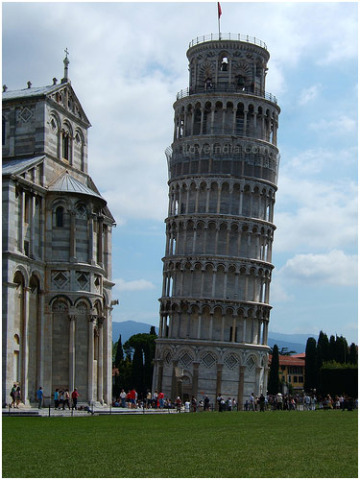
Interesting & Fun Facts about Leaning Tower of Pisa
- The height of the Tower is 58.36 meters from the foundation and 55 meters from the ground.
- The Tower is an 8 storied building.
- There are seven bells located in the bell Tower, all tuned to musical scales.
- The weight of the Tower is measured to be 14,453 tons.
- The area of the annular foundation is 285 sq m and the average pressure on the ground is 497 kPa.
- The present inclination of the Tower is measured to be about 10%. Moreover, the value corresponding to the eccentricity on the loads on the foundation is 2.3 meters.
- The Tower has a cylindrical body, encircled by arcades with arches and columns resting upon the base, surmounted by a belfry.
- The central body is basically a hollow cylinder, which comprises of an external wall facing of shaped ashlars, in white and grey San Giuliano limestone and an inner wall facing of worked limestone. Between these two wall facings, an annular masonry area is provided.
- The masonry area within the two walls comprises of a spiral staircase with 293 steps, leading to the sixth arcade.
- The construction work of the Tower began on 9th August, 1173.
- In 1182, the Stone Works of the Bell Tower of Saint Mary were established.
- The height of the fourth order (storey) was interrupted in 1185.
- In 1198, the establishment of the first bell was documented.
- In 1231, the marble used for the construction of the Tower was worked on.
- In 1260, Giovanni di Simone intervened in the construction work of the Tower as the master builder.
- In 1278, the structure reached up to the seventh order, where a correction of the axial inclination of the building was made. It was no longer rectilinear, having assumed a concave form. Following this, the construction work was once again suspended.
- In 1292, Giovanni Pisano measured the inclination of the Tower.
- Eventually, the Tower was completed by Tommaso Pisano in 1360, who erected the belfry, making the last important geometric correction of the structure.
- The identity of the architect of the legendary Tower is still unknown.
- The reason behind the inclination of the Tower still remains a mystery. However, as per the inference derived from the recent research, it is believed that the inclination was due to the subsidence of the foundation soil, which was a mixture of varied deposits and clayish material.
- In 1817, two English scholars, Cresy and Taylor, confirmed the fact that there had been minimal oscillation of the building over the centuries, as the Tower might have become harmonious with the subsoil.
- In 1838, an increased acceleration of the oscillating movement was observed, leading to conservation work.
- It is surprising to note that the inclination of the Tower, measured between 1550 and 1817 by Giorgio Vasari and Cresy and Taylor respectively, was found to have increased by a mere 5 cm. On the other hand, after the conservation work in 1838, the inclination was discovered to have increased by 20 cm.
- The Tower has been closed for public since 1988, to prevent it from any susceptible danger of elevating its inclination.
How to Cite


See also
More from iloveindia.com
- Home Remedies | Ayurveda | Vastu | Yoga | Feng Shui | Tattoos | Fitness | Garden | Nutrition | Parenting | Bikes | Cars | Baby Care | Indian Weddings | Festivals | Party ideas | Horoscope 2015 | Pets | Finance | Figures of Speech | Hotels in India : Delhi | Hyderabad | Chennai | Mumbai | Kolkata | Bangalore | Ahmedabad | Jaipur
- Contact Us Careers Disclaimer Privacy Policy Advertise With Us Lifestyle Sitemap Copyright iloveindia.com. All Rights Reserved.