Manatee is an aquatic mammal that is quite gentle and slow moving. Read this article and get some more interesting facts and amazing information on manatee.
Facts About Manatee
Did you know that mermaid stories have been inspired by manatees? Manatee is the name of an aquatic mammal, found inhabiting Florida and southeastern Georgia. It has a large body that narrows down to a flat, paddle-shaped tail. The mammal has two forelimbs, called flippers, with three to four nails on each. Manatees have a wrinkled head and face, with minimal hair on the body. However, they do have a set of whiskers adorning their snout. They can be found in shallow, slow-moving rivers, estuaries, saltwater bays, canals and coastal areas. Gentle aquatic mammals as these are, manatees are herbivores and these indulge in a variety of plant vegetation. These are now listed in the Endangered Species List and strict measures are taken to ensure their safety and habitat. Being a migratory species, manatees can be seen in place quite far away from their habitat, in summers. Read on to get some more interesting facts and amazing information on manatee.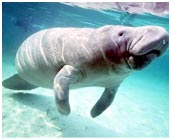
Facts about Manatee
Kingdom: Animalia
Phylum: Chordata
Class: Mammalia
Order: Sirenia
Family: Trichechidae
Genus: Trichechus
Species: Trichechus inunguis, Trichechus manatus, Trichechus senegalensis and Trichechus bernhardi (validity questionable)
Length: 2.8 to 3.0 m (9 to 10 ft)
Weight: 400 to 550 kg (900 to 1200 lb)
Swimming Speed: 5 to 8 km/hr
Diet: 60 different plant species
Natural Habitat: Warm, shallow, coastal estuarine waters
Age: Over 60 years
Age of Maturity (males): 9 years
Age of Maturity (females): 5 years
Gestation Period: 12 months
Number of Offspring: One
Interesting & Amazing Information on Manatee
-
Manatee is the official state marine mammal of Florida.
-
Manatees are believed to have evolved from a wading, plant-eating animal. Their closest land relatives are elephant and hyrax.
-
Manatees are a migratory species and the animal can be found migrating to distant areas in summers.
-
A manatee spends most of its time in eating, resting and traveling.
-
On an average, manatees travel about 40 to 50 miles a day
-
Manatees graze for food along water bottoms and on the surface.
-
A manatee usually rests submerged at the bottom or just below the surface. It has to come up to breathe, on an average of every 3-5 minutes, when active, and every 10-15 min, when resting.
-
Manatees give birth to a single young one, known as calf, every 2-5 years. Twins are very rare.
-
The calf of a manatee usually remains dependent on its mother for one to two years.
-
It is believed that manatees are near-sighted, but can differentiate between colors.
-
Manatees do not have external ear lobes, still they can hear pretty well.
-
The sounds emitted by manatees are within the range of human ear. They squeak and squeal, when frightened, playing or communicating.
-
A manatee is capable of exchanging 98 percent of its lungs capacity in a single breath.
-
Manatees can eat 10-15 percent of their body weight daily.
-
Manatees are an endangered species, protected under the Federal Endangered Species Act, Federal Marine Mammal Protection Act and Florida Manatee Sanctuary Act.
-
Usually prefer to live in waters that are 60 ºF and warmer. During winters, these migrate to Florida, where the waters are much warmer.
-
This aquatic creature has thick hairless skin, streamlined body and a horizontally flat tail.
-
Human settlement and man-made developments are the main cause of the significant reduction in their population.
-
Evidence shows that these extremely endangered species had evolved over 60 million years ago.
-
These marine mammals swim very slowly and their average speed is only 5 miles per hour.
-
A manatee can breathe air through its nose and can close its nostrils when under water.
-
In 1996, about 150 manatees died in one region due to red tide, which is an algal bloom producing toxins in the water.
-
Manatees are sometimes called ‘sea cows’ as they look very similar to cows.
How to Cite



See also
More from iloveindia.com
- Home Remedies | Ayurveda | Vastu | Yoga | Feng Shui | Tattoos | Fitness | Garden | Nutrition | Parenting | Bikes | Cars | Baby Care | Indian Weddings | Festivals | Party ideas | Horoscope 2015 | Pets | Finance | Figures of Speech | Hotels in India : Delhi | Hyderabad | Chennai | Mumbai | Kolkata | Bangalore | Ahmedabad | Jaipur
- Contact Us Careers Disclaimer Privacy Policy Advertise With Us Lifestyle Sitemap Copyright iloveindia.com. All Rights Reserved.