Woodpeckers are a large family of birds known for their typical ‘pecking behavior’. Check out some interesting facts and amazing information about woodpeckers.
Facts About Woodpeckers
Woodpeckers are some of the most recognizable birds all around the world. From kids to the elderly, the common woodpecker is one of the few birds that you will not fail to identify, whether they are comfortably seated on poles, trees of even the door of your house! Woodpeckers are a large family of birds belonging to the order ‘Piciformes’ that are scattered across the forested areas of the globe. They owe their name to their characteristic habit of drumming and pecking noisily on tree with the help of their beaks. Normally, this pecking behavior in woodpeckers is a way of signaling territorial possession, as well as a method of locating food in the tree barks such as insect larvae and tree sap. They have certain specialized physical traits like ‘shock-absorber’ head musculature, long tongues, pointed nails, and stiff tail feathers that help them to balance and clutch themselves upright on trees. Check out some interesting and amazing information about woodpeckers here.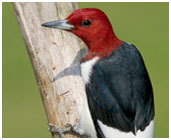
Interesting & Amazing Information On Woodpeckers
Kingdom: Animalia
Phylum: Chordata
Class: Aves
Order: Piciformes
Family: Picidae
Subfamily: Picinae
Genera: Melanerpes, Sphyrapicus, Xiphidiopicus, Dendropicos, Dendrocopos, Picoides, Veniliornis, Campethera, Geocolaptes, Dinopium, Meiglyptes, Hemicircus, Micropternus, Picus, Mulleripicus, Dryocopus, Celeus, Piculus, Colaptes, Campephilus, Chrysocolaptes, Reinwardtipicus, Blythipicus, Gecinulus
Sapheopipo
Species: More than 200
Natural Habitat: Forested Areas
Diet: Tree sap, nuts, insect larvae etc
- There are more than 200 species of woodpeckers scattered all over the world.
- Most woodpeckers have zygodactyl feet with the arrangement of four toes - two pointing forward and the other two pointing backward.
- Woodpeckers have very long tongues, which it uses for wriggling on to difficult places in order to capture preys.
- The most common color combinations for woodpeckers are red, yellow, black and white.
- The greatest threat to woodpeckers is through deforestation and urban development, which hinders with their nursing, nesting and feeding habits.
- Between drumming and nesting cavities, Woodpeckers can peck upto 20 times per second, or a total of 10,000-12,000 pecks per day.
- ‘Piculets’ are the smallest woodpeckers found in the world and are commonly found in Asia and South America. They only measure up to 3-4 inches.
- Woodpeckers have short legs and very pointed nails, which makes it easier for them to clutch on to the barks of trees.
- Woodpeckers have a pair of firm and centrally located tail feathers that supports and keeps them upright on trees.
- None of the species of woodpeckers are found in New Zealand, Madagascar or Australia.
- The largest woodpeckers in the world are the ‘ivory-billed woodpecker’ and the ‘imperial woodpecker’, both of which may be extinct today.
- Typically, a woodpecker’s diet consists of nuts, seeds, bugs, fruits and tree sap.
- Woodpeckers are born with ‘zygodactyl’ feet, which means that they have toes that face both the front, and the back.
- Woodpeckers are not vocal birds. They are more of drummers and drum on echoing objects such as hollow trees, doors, chimneys and poles.
- A very thick skull and squashy bone protects the brain of woodpeckers from shocks caused by persistent pecking behavior.
- Stubbly and coarse feathers over their nostrils help woodpeckers to ward off wood flakes created by pecking.
- Both parents engage in the incubation of young ones, who are born naked and blind.
- The average life expectancy for a woodpecker is 5-11 years.
- All woodpeckers fly in a typical pattern, with three flaps followed by a single glide.
- Woodpeckers create new holes every year. Thus, old cavities drilled by them are used by other hole-nesting species such as starlings, chickadees, owls, and squirrels.
- The most recognized woodpecker is the fictitious, ‘Woody Woodpecker’, created by Bugs in 1940. Despite its widespread popularity, this bird is not a member of the woodpecker species.
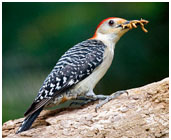
How to Cite


See also
More from iloveindia.com
- Home Remedies | Ayurveda | Vastu | Yoga | Feng Shui | Tattoos | Fitness | Garden | Nutrition | Parenting | Bikes | Cars | Baby Care | Indian Weddings | Festivals | Party ideas | Horoscope 2015 | Pets | Finance | Figures of Speech | Hotels in India : Delhi | Hyderabad | Chennai | Mumbai | Kolkata | Bangalore | Ahmedabad | Jaipur
- Contact Us Careers Disclaimer Privacy Policy Advertise With Us Lifestyle Sitemap Copyright iloveindia.com. All Rights Reserved.