Chimpanzees, also known as chimps, are native to Africa. To help you know more about the animal, we have provided some interesting facts and amazing information on it, here.
Facts About Chimpanzee
Chimpanzees are known to be boisterous and curious. One of the most fascinating mammals in the animal directory, Chimpanzees are now slowly becoming an endangered species. Chimpanzees are one of four types of great apes in the world, apart from gorillas, bonobos and orangutans. They are found occupying mainly the rain forests, woodlands and grasslands of West and Central Africa. A chimpanzee has face that is pinkish to blackish in color. Its entire body is covered with long black hair, with the exception of face, ears, fingers and toes. One major difference that distinguishes chimpanzees from monkeys is that the former does not have a tail. Chimpanzees have opposable thumbs and toes that help them in grasping objects easily. They have an omnivorous diet, which mainly includes fruit, plants, insects, eggs and meat. They also live up to about 50 years while bred in captivity and just over 30 years if left in the wild. To get some more interesting facts and amazing information on chimps, read on.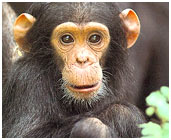
Fast Facts
Kingdom: Animalia
Phylum: Chordata
Class: Mammalia
Order: Primates
Family: Hominidae
Subfamily: Homininae
Tribe: Hominini
Subtribe: Panina
Genus: Pan
Type Species: Simia troglodytes
Species: Pan troglodytes and Pan Paniscus
Height (males): 3 to 4 feet
Weight (males): 35 to 70 kg
Height (females): 2 to 3½ feet
Weight (females): 26 to 50 kg
Natural Habitat: West and Central Africa
Diet: Fruit and plants, apart from insects, eggs and meat
Age: 40 years (in wild), 60 years (in captivity)
Age of Maturity (females): 13 years
Age of Maturity (males): 16 years
Gestation Period: 230 to 240 days (around 8 months)
Number of Offspring: One
Status: Endangered
Interesting & Amazing Information On Chimpanzees
- A female chimpanzee can give birth at any time of year. However, she gives birth every 3-4 years.
- A male chimpanzee hardly leaves the community into which he was born. However, the females frequently change her community in adolescence.
- Chimpanzees are vulnerable to many human diseases, like measles, influenza, hepatitis B, ringworm and cold sores.
- Chimpanzees build relationships within their community by grooming each other. This is also believed to calm the nerves of a nervous/excited chimpanzee.
- Chimpanzees have the knowledge of working with tools. They poke grass stems or twigs into termite or ant nests and eat the insects that cling to them. They can also break nut shells with the help of stones.
- Chimpanzees live in social communities of several dozen animals, known as troops. Hierarchies are formed by the adult males of a community, who are led by an Alpha Male.
- Chimpanzees might organize hunts periodically, to catch monkeys or small antelopes.
- Chimpanzees are both terrestrial and arboreal, spending most of the day on the ground and diurnally feeding after sunset.
- Chimpanzees share more than 98 percent of the human DNA.
- Chimpanzees use a complicated system of sounds to communicate with each other.
- Chimpanzees use large sticks and branches as clubs or even throw them at enemies, just like humans.
- Infant chimps have a white tail tuft when they are born, which disappears during their childhood.
- Chimpanzees are one of the four types of great ape.
- Chimps touch each other a lot and may even kiss when they meet. They have also been seen holding hands and grooming each other.
- It has been noticed by scientists that chimpanzees use medicinal plants to treat themselves for illness and injury.
- Female chimpanzees have an estrus cycle of about 34-35 days after reaching sexual maturity at about 8 -10 years.
- Chimpanzees are also known to hunt bushbuck and smaller monkeys for prey.
- Male chimpanzees show off their physical strength and power through ‘displays’.
- When a mother chimpanzee dies, her orphaned offspring have very little chance of surviving.
- Chimpanzees have five to six times the strength of a powerful human being.
- Chimpanzees can be found in over 21 African countries, but are mostly found in central Africa.
- Though chimpanzees are quadrupedal i.e. walk on all four limbs, they can easily stand and walk upright.
- Chimpanzees are endangered mammals. A great threat to the existence of chimpanzees is commercial forest hunting for chimpanzee meat.

How to Cite





See also
More in 'Society'
More from iloveindia.com
- Home Remedies | Ayurveda | Vastu | Yoga | Feng Shui | Tattoos | Fitness | Garden | Nutrition | Parenting | Bikes | Cars | Baby Care | Indian Weddings | Festivals | Party ideas | Horoscope 2015 | Pets | Finance | Figures of Speech | Hotels in India : Delhi | Hyderabad | Chennai | Mumbai | Kolkata | Bangalore | Ahmedabad | Jaipur
- Contact Us Careers Disclaimer Privacy Policy Advertise With Us Lifestyle Sitemap Copyright iloveindia.com. All Rights Reserved.